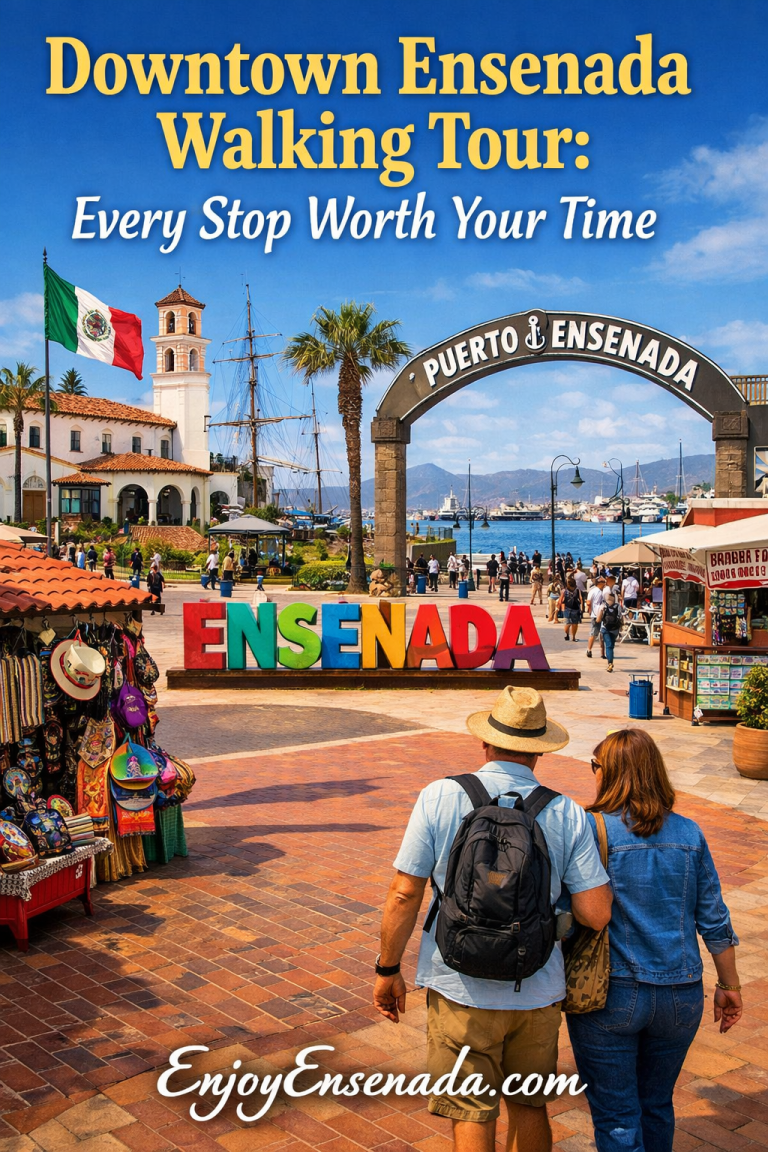
A downtown Ensenada walking tour is not a long commitment. The entire downtown core is compact enough to cover on foot in two to three hours, and everything that matters — the waterfront, the markets, the historic buildings, the food, the bars — sits within a few blocks of each other. What changes the experience is knowing the order, knowing what each stop actually is, and knowing which ones deserve more than a passing glance.
This walking tour is designed for cruise passengers with a port day, road-trippers staying a night or two, and anyone who wants to understand how downtown Ensenada is actually laid out before they start walking. It follows a logical route from the cruise terminal outward, but it works equally well if you are starting from a downtown hotel or arriving by car.
Where the Walk Begins: The Port and the Malecón
The natural starting point for any downtown Ensenada walking tour is the waterfront. Whether you arrive by cruise ship, by car, or on foot from a nearby hotel, the Malecón — Ensenada’s waterfront promenade — is the orientation point for everything that follows.
The Malecón runs along the main harbor where fishing boats, private yachts, and cruise liners all share the same stretch of Pacific waterfront. It is wide, paved, and easy to walk. It is also one of the few places in downtown Ensenada where the city reveals its essential character without any commercial pressure — the open bay, the boats coming and going, the enormous Mexican flag that flies above the civic plaza, and the hills of the city rising behind it.
Spend time here before you start moving inland. The view from the Malecón is the postcard version of Ensenada, and it contextualizes everything else you will see on the walk. The harbor is working, not decorative — the fishing fleet here is active and commercial, and the smell of the ocean and the sound of the boats are part of the experience.
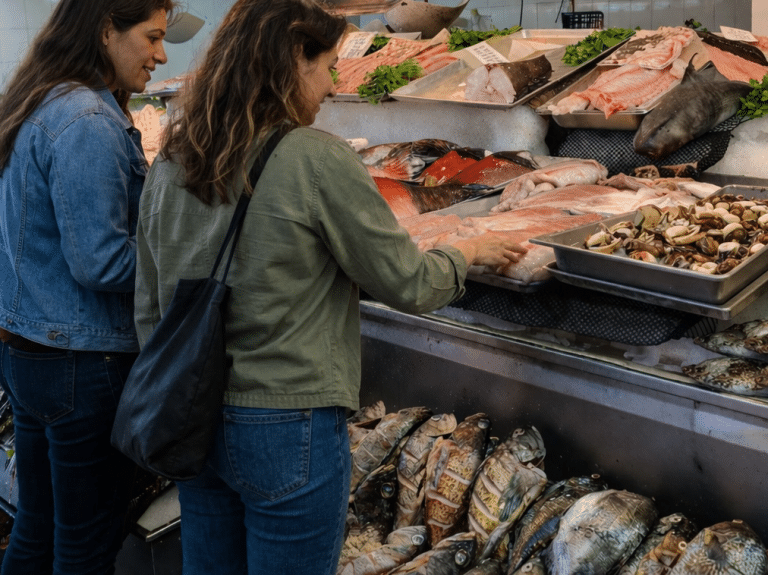
Walking south along the Malecón from the cruise terminal, you will pass taco stands, fishmongers with the morning’s catch on display, and an open-air market. This is not a formal market with a fixed address — it is the informal economy of a port city that has operated this way for generations.
Stop 1: Mercado Negro — The Fish Market
Just off the harbor, steps from the Malecón, sits Mercado Negro — Ensenada’s historic fish market and one of the most visceral food experiences in the city. The name translates as the Black Market, a reference to its origins as an informal trading point rather than anything illicit.
The market operates as an open-air space where local fishermen bring in their daily catch. What arrives here — shrimp, lobster, sea urchin, octopus, tuna, oysters, clams, and species you will not find in a standard fish counter — comes directly off boats that docked that morning. The immediacy of it is the point.
Beyond buying raw fish, Mercado Negro has a cluster of food stalls and small restaurants serving prepared seafood. The ceviche here — fresh fish marinated in lime juice with avocado, tomato, and cilantro — is among the best versions of the dish you will find anywhere in Ensenada. The tostadas, piled with mixed seafood and layered with house salsas, are the format most vendors specialize in.
This is not a polished food hall experience. It is loud, busy, and entirely authentic. Budget at least 30 minutes here, longer if you intend to eat.
Stop 2: Plaza Cívica — Las Tres Cabezas
From the fish market, a short walk brings you to Plaza Cívica, known locally as Las Tres Cabezas — The Three Heads. The plaza takes its nickname from three large sculpted busts that dominate its center: Benito Juárez, Miguel Hidalgo y Costilla, and Venustiano Carranza — three of the most significant figures in Mexican political and revolutionary history.
The plaza is the civic heart of downtown Ensenada. The enormous Mexican flag that is visible from the harbor flies from a pole here, and the scale of it — one of the largest in the region — is striking up close in a way it is not from a distance. It is a deliberate statement of national identity in a border city that draws millions of foreign visitors.
The plaza is a good place to pause and get your bearings. From here, Avenida Lopez Mateos is directly accessible, the Riviera del Pacífico is close by, and the street grid of the downtown core opens up in every direction.
Stop 3: Riviera del Pacífico
One of the most overlooked stops on any downtown Ensenada walking tour is the Riviera del Pacífico — a building that most visitors walk past without realizing what it is.
The Riviera del Pacífico was built in 1930 as a luxury casino and hotel, designed to attract wealthy Americans fleeing Prohibition. For a brief period it placed Ensenada on the international glamour map — the building was visited by Mexican presidents, international artists, and political figures of the era. There is also a persistent local claim that the margarita was invented here, though Hussong’s Cantina makes the same claim with equal conviction.
The casino closed in 1964. The building was later restored and reopened as a cultural center and museum. Today it houses the Regional Historical Museum, which covers Ensenada’s history from its pre-Hispanic origins through the Spanish colonial period and into the modern era. The building itself — its architecture, its murals, its gardens — is worth visiting independently of the museum collection.
This is consistently cited as the most beautiful building in Ensenada, and it is free or very low cost to enter the grounds. Budget 45 minutes to an hour if you intend to see the museum properly.
Stop 4: Avenida Lopez Mateos
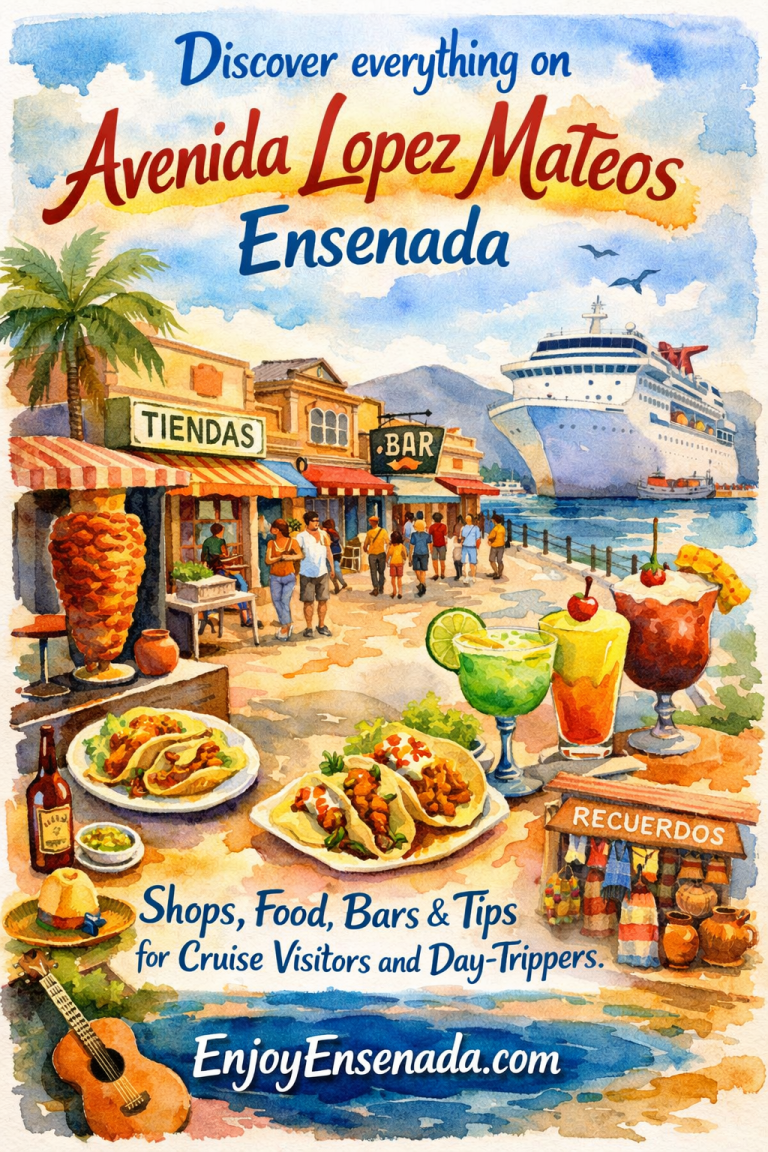
From the Riviera del Pacífico, you are a short walk from Avenida Lopez Mateos — the commercial main street of downtown Ensenada and the section of the city most visitors spend the majority of their time in.
The avenue runs four blocks from Calle Castillo to Avenida Riveroll, with shops, restaurants, cafes, and bars on both sides for the full length. The southern end has the better quality shops — silver jewelry, Mexican designer clothing, folk art — while the northern end is more densely packed with souvenir vendors. Starting from the south end and working north puts the best of the street first.
For a full breakdown of what is on every block — the specific shops, taco stands, and bars that define the avenue — see our dedicated Avenida Lopez Mateos guide.
Stop 5: La Guerrerense
At the corner of Avenida Lopez Mateos and Alvarado, La Guerrerense is one of those rare street food operations that has outgrown its own origins without losing what made it worth seeking out in the first place. Sabina Bandera started here as a street cart vendor and has since been recognized at food festivals internationally — but the cart is still on the corner, still serving the same tostadas that built the reputation.
The tostadas at La Guerrerense are not a single item. They are a rotating selection of fresh seafood preparations — sea urchin, smoked tuna, octopus, clam — each served on a crisp tostada base with a rotating cast of house-made salsas. The salsas alone are worth the stop. This is Ensenada’s culinary identity in its most concentrated form.
It is a standing operation. You order, you eat, you move on. There is no table service and no menu in the conventional sense — you point at what looks good and trust the process.
Stop 6: Hussong’s Cantina
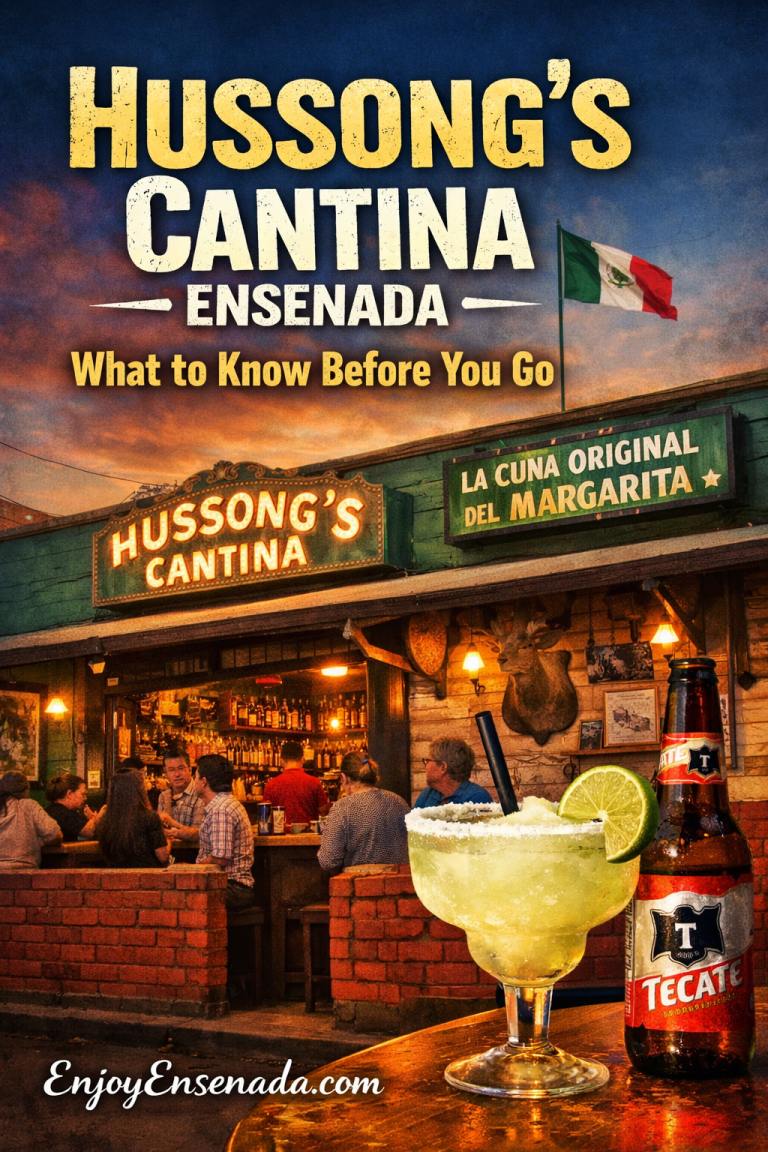
Hussong’s Cantina has been on the same block since 1892, which makes it one of the oldest continuously operating bars in all of Baja California. The interior has changed very little in that time — sawdust on the floor, a long scarred wooden bar, walls decorated with generations of memorabilia, and an atmosphere that feels genuinely earned rather than manufactured.
Hussong’s claims to be the birthplace of the margarita. The story goes that in the 1940s, a bartender here created the drink for a regular customer named Margarita. Whether or not this is historically accurate — and the claim is contested — the margaritas served here are the natural thing to order. The cantina also serves traditional Mexican food, hosts live music, and operates at full energy during port days when cruise passengers fill every available space.
Go in the morning or early afternoon if you want the atmosphere without the crowd. Go in the evening if the crowd is the point. Either version of Hussong’s is worth experiencing at least once.
Stop 7: The Craft Beer District
One of the less-publicized developments in downtown Ensenada over the past decade is the emergence of a genuine craft beer scene concentrated in and around the downtown core. Several taprooms and breweries operate within walking distance of Avenida Lopez Mateos, offering locally brewed beers that reflect the same regional ingredient focus that defines the food and wine scene in the broader Ensenada area.
This is not a single destination — it is a cluster of small operations that reward wandering. The craft beer scene here is younger and less codified than the wine culture of Valle de Guadalupe, which is part of its appeal. For a full guide to the breweries accessible on foot from downtown, see our Ensenada breweries guide.
Stop 8: Chapultepec Hill and El Mirador
For those with energy remaining after the main downtown circuit, the walk up to El Mirador — the viewpoint on Chapultepec Hill — provides the best elevated view of Ensenada available without a car. The climb is modest and the reward is a panoramic view of the city, the bay, the harbor, and on clear days the outline of Todos Santos Island offshore.
This is where the photograph that captures the full scale of the city gets taken. The bay view from El Mirador shows Ensenada as a coastal city in a way that the street-level experience does not — the hills, the water, the port infrastructure, and the city spreading inland all become legible from up here in a single frame.
The walk up and back adds approximately 30 to 45 minutes to the tour and is entirely optional. For visitors who are comfortable on their feet and want to end the walk with something quieter and more panoramic than the commercial energy of the avenue, it is the right ending.
How Long Does the Walking Tour Take?
The route described here — from the Malecón through the fish market, Plaza Cívica, Riviera del Pacífico, Avenida Lopez Mateos, La Guerrerense, Hussong’s, and optionally up to El Mirador — takes between two and four hours depending on how long you linger at each stop.
Cruise passengers with a standard port day have enough time to complete the full route comfortably, including a sit-down meal or extended time at the fish market, as long as they account for the 20-minute walk back to the terminal. Building in a buffer before departure is advisable.
Road-trippers and overnight visitors can spread the route across a morning and an afternoon, using the midday hours for a longer meal at one of the restaurants on or near Avenida Lopez Mateos before continuing to the afternoon stops.
What to Know Before You Start
Downtown Ensenada is flat and walkable. The streets are paved and the main tourist zone is well-maintained, though some sidewalks — particularly on Avenida Lopez Mateos — have uneven sections that require attention if you have mobility concerns.
US dollars are accepted broadly throughout the downtown tourist zone. Paying in Mexican pesos typically results in a better effective rate, particularly for food and small purchases from vendors.
The downtown core is considered safe for tourists during daylight hours. Police presence is visible, and the area is well-traveled. Standard urban awareness applies — keep your belongings secure and be aware of your surroundings — but there is no reason to approach a downtown Ensenada walking tour with unusual caution.
For a broader understanding of safety in Ensenada beyond the downtown area, our Is Ensenada Safe guide covers the full picture.
Ensenada’s downtown is the beginning of what the city offers, not the whole of it. Valle de Guadalupe is 40 minutes away. La Bufadora is 45 minutes by car. The beaches extend in both directions from the harbor. But the walk described here gives you the city’s identity in a few hours — its history, its food, its character — in a way that no single destination within it can on its own.
 Traveler